What happens when the world’s biggest software company stops selling an AI chatbot and starts selling an AI workforce? On Friday, investors answered with an 18-dollar move in Microsoft stock.
Microsoft (MSFT) closed at $516.17 on Friday, September 25, 2026, up 3.66% and the standout large-cap of the session. The catalyst: a rebuilt, enterprise-only Copilot that folds chat, a plain-language app builder and a background agent called Autopilot into one product, followed by an Oppenheimer price-target bump. The S&P 500 and Nasdaq both finished the week higher. Here is how an AI stock analysis platform would have read the day.
The 60-second market dashboard
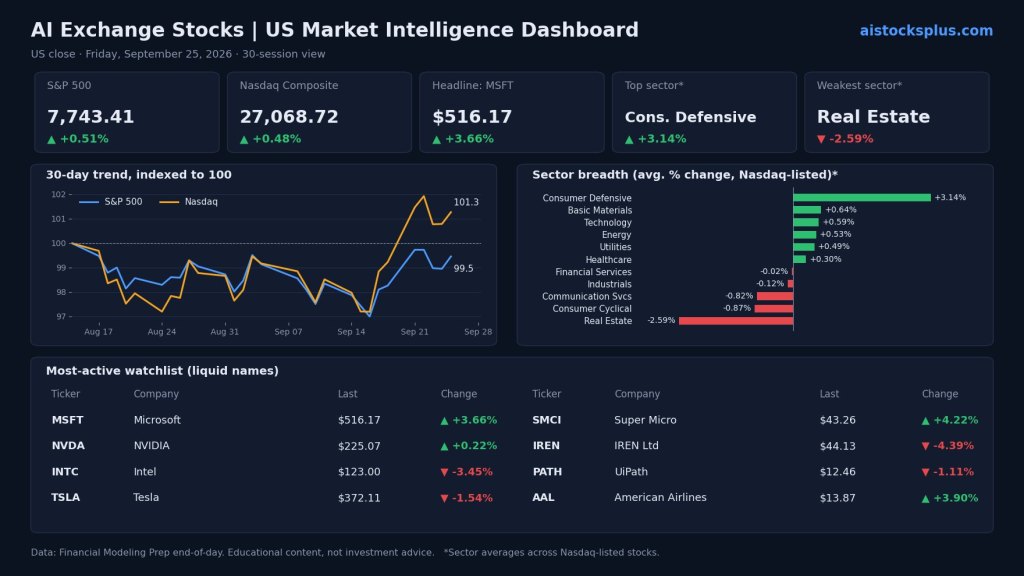
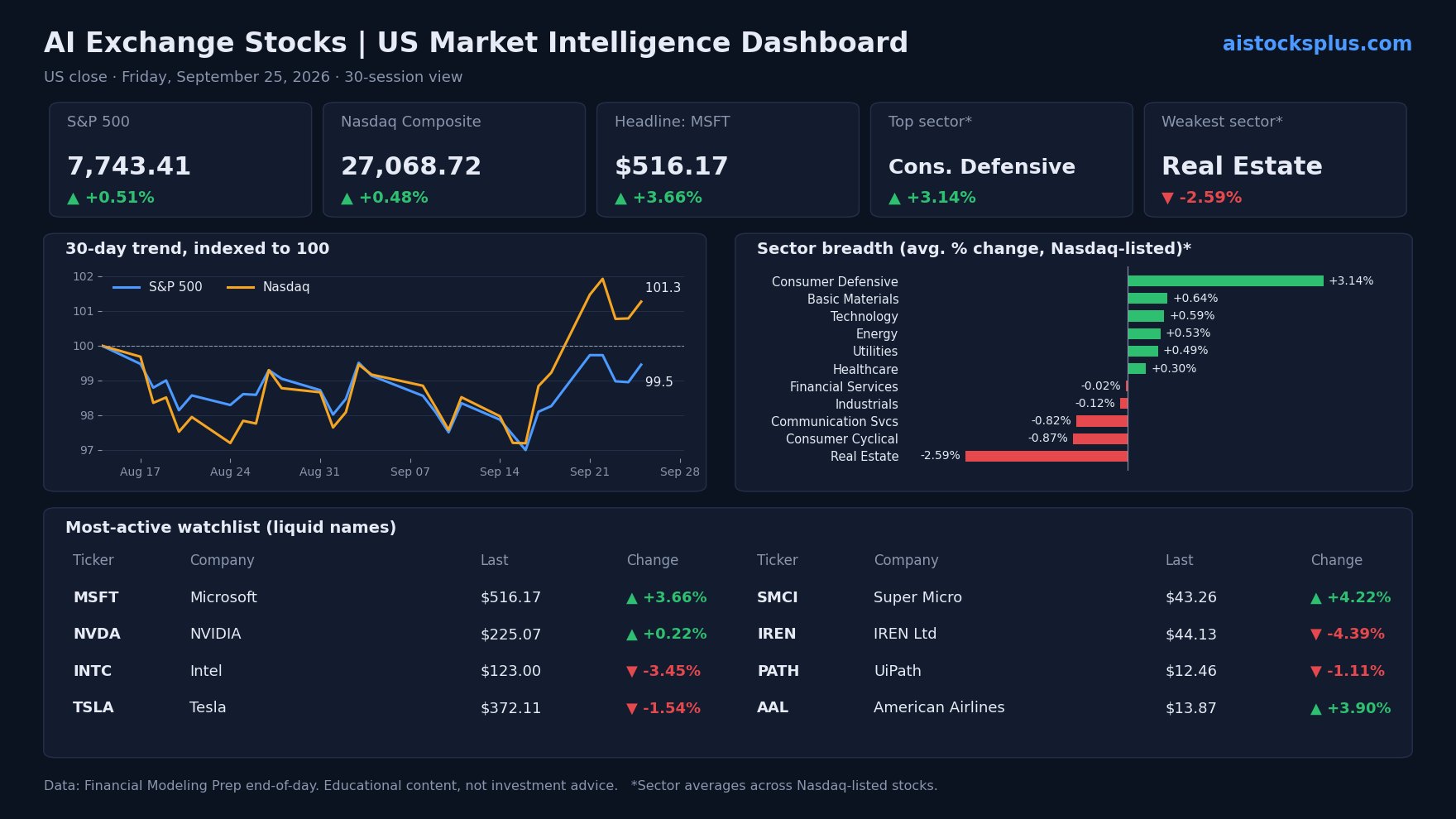
- S&P 500: 7,743.41, up 0.51% on the day and about 1.2% for the week (from 7,650.50 on Sept 18).
- Nasdaq Composite: 27,068.72, up 0.48% on the day and roughly 2.1% for the week.
- 30-session trend: indexed to 100, the Nasdaq sits near 101.3 while the S&P 500 is near 99.5, so tech is still doing the heavy lifting.
- Headline stock: Microsoft +3.66% to $516.17 on about 37.9 million shares, roughly 15% above its three-month average volume (per The Motley Fool).
- Sector breadth (Nasdaq-listed averages): Consumer Defensive led at +3.14%, Technology +0.59%; Real Estate lagged at -2.59%, with Consumer Cyclical -0.87% and Communication Services -0.82%.
- Most-active movers: Super Micro +4.22%, NVIDIA +0.22%, Intel -3.45%, Tesla -1.54%, IREN -4.39%.
What an AI stock analysis platform would have flagged
1. Stock market sentiment analysis turned decisively positive on MSFT. The narrative shifted from “is Copilot worth the price?” to “customers are standardizing on it.” Oppenheimer’s Brian Schwartz lifted his target to $570 from $515 and kept an Outperform rating, and Microsoft says it has more than 30 million paid enterprise Copilot seats (24/7 Wall St.). A sentiment model scoring headlines and analyst notes would have seen tone flip in a single session.
2. A volume anomaly confirmed the move. Price moves on thin volume fade easily. Friday’s MSFT volume ran about 15% above normal, which is the kind of confirmation real-time exchange analytics look for before treating a breakout as meaningful rather than noise.
3. Predictive financial modeling now has new inputs. Copilot’s new pricing mixes fixed subscriptions for chat with usage-based billing for agent work. For machine learning finance models, that means revenue forecasts should start tracking agent consumption, not just seat counts. The counterweight is spending: Microsoft’s roughly $115 billion 2026 capex plan keeps return-on-investment questions alive.
4. Automated investment research surfaces the relative-value gap. Even after Friday, MSFT is up only about 7% year-to-date versus roughly 37% for the broader technology sector (24/7 Wall St.). Automated screens that compare a stock’s momentum to its sector would flag MSFT as a laggard getting a fresh catalyst, a very different setup from a stock that is already crowded.
Where algorithmic trading tools and AI portfolio optimization fit
Days like this are why algorithmic trading tools pair price triggers with context: a 3.7% move on above-average volume with a named catalyst deserves a different response than a random spike. On the portfolio side, AI portfolio optimization would weigh MSFT’s renewed momentum against concentration risk, since mega-cap tech already dominates most index-heavy portfolios, and against Friday’s sharp split between a strong Consumer Defensive group and a weak Real Estate group.
That is the promise of smart wealth management built on FinTech investing software: fewer gut calls, more signal-based decisions with the reasoning visible. You can explore dashboards that combine sentiment, volume and sector breadth at AIStocksPlus.
Key takeaways for next week
- Follow-through on MSFT: watch whether volume stays elevated early in the week. Strong moves that hold on volume tend to carry more information than one-day pops.
- Agent-pricing read-through: keep an eye on how peers such as Alphabet and Oracle respond; Oracle slipped 1.75% while Alphabet rose 0.46% on Friday (The Motley Fool).
- Quarter-end on Wednesday, Sept 30: window dressing and rebalancing can distort flows in the final sessions of Q3.
- Macro inputs: Friday’s gains came despite a bond sell-off and choppy oil prices; the September jobs report, typically due the first Friday of October, is the next big data point.
- Breadth check: the Nasdaq is outrunning the S&P 500 over 30 sessions. Watch whether gains broaden beyond tech or stay narrow.
#AIStocks #AIInvesting #StockMarket #FinTech #MachineLearning #AlgoTrading #PredictiveAnalytics #SentimentAnalysis #WealthManagement #StockMarketToday #MSFT #Microsoft #Copilot #NVDA #INTC #TSLA
Sources: Financial Modeling Prep end-of-day index, sector and most-active data; The Motley Fool, 24/7 Wall St., Yahoo Finance and TheStreet market coverage for Sept. 25, 2026. This article is for educational and informational purposes only and is not investment advice. Always do your own research or consult a licensed financial professional.


Leave a comment