One product launch added roughly $18 a share to Microsoft in a single session. Did your research tools see it coming — or did you read about it after the close?
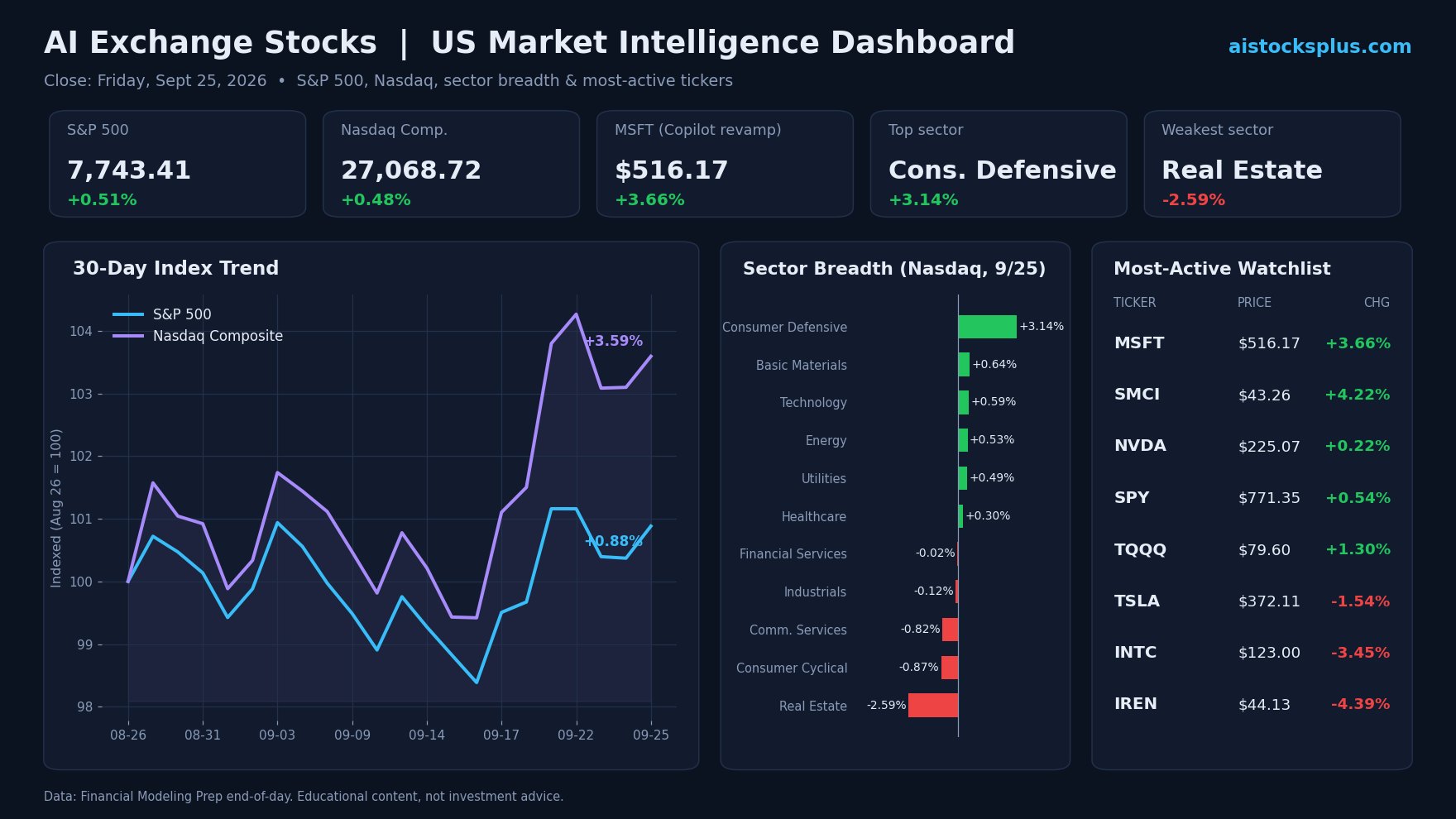
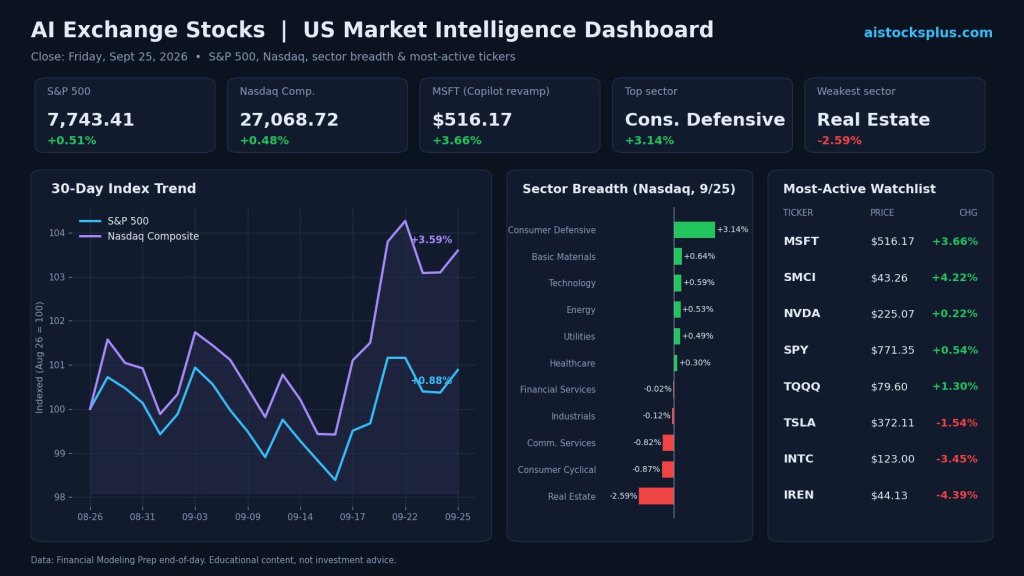
Friday, September 25, 2026 was a textbook example of why real-time exchange analytics and AI stock analysis matter. The S&P 500 closed at 7,743.41 (+0.51%) and the Nasdaq Composite at 27,068.72 (+0.48%) — a quiet tape on the surface. Underneath, capital was rotating hard between sectors and one mega-cap AI story dominated volume.
📊 The 60-second market dashboard
- Microsoft (MSFT) +3.66% to $516.17 after unveiling a redesigned Copilot with code generation and always-on agentic AI tools. Volume ran about 15% above its three-month average — a classic sentiment + volume confirmation signal.
- Sector breadth split wide open: Consumer Defensive led Nasdaq sectors at +3.14%, while Real Estate fell 2.59%. A 5.7-point spread in one session is exactly what AI-driven sector rotation models are built to catch.
- AI infrastructure mixed: Super Micro (SMCI) +4.22%, NVIDIA (NVDA) +0.22% to $225.07, while Intel (INTC) slipped 3.45% and IREN fell 4.39%.
- 30-day trend: Since Aug 26 the Nasdaq is up about 3.6% versus 0.9% for the S&P 500 — tech leadership is still intact.
🤖 What an AI stock analysis platform would have flagged
Moves like these rarely come out of nowhere. Modern machine learning finance models combine several signals that a human scanning headlines can easily miss:
- Stock market sentiment analysis — NLP models score product-launch coverage, analyst notes and social chatter in real time. A sentiment spike on an AI-product story is often the first tell.
- Volume anomaly detection — when volume runs well above its 90-day average while price moves decisively, the move is more likely to hold than a low-volume drift.
- Predictive financial modeling — sector-rotation models track relative strength across all 11 sectors, surfacing days like Friday when defensives and rate-sensitive groups diverge sharply.
- Automated investment research — instead of reading ten articles, an AI research engine summarizes catalysts, price-target changes and risk factors into one card per ticker.
⚙️ Algorithmic trading tools + AI portfolio optimization: the new normal
The big story in 2026 isn’t whether AI belongs in investing — it’s how fast the gap is closing between institutional algorithmic trading tools and what individual investors can access. AI portfolio optimization now lets anyone test how a sector-rotation day like Friday would have affected their allocation, rebalance risk exposure, and set alerts that fire on sentiment and volume — not just price.
That is the thinking behind AIStocksPlus: a FinTech investing software platform that brings AI stock analysis, real-time exchange analytics and sentiment scoring into one smart dashboard for smart wealth management.
🔑 Key takeaways for next week
- Watch whether MSFT holds its breakout on above-average volume — confirmation matters more than one session.
- Track whether the defensive-vs-real-estate spread persists; persistent rotation often signals a shift in rate expectations.
- Keep an eye on AI-infrastructure names (NVDA, SMCI, INTC) for divergence as the market weighs AI capex against returns.
Share this: #AIStocks #AIInvesting #StockMarket #FinTech #MachineLearning #AlgoTrading #PredictiveAnalytics #SentimentAnalysis #WealthManagement #Investing #MSFT #NVDA #Nasdaq #SP500 #StockMarketToday #AgenticAI
Data: Financial Modeling Prep end-of-day data for Sept 25, 2026; Microsoft news via Motley Fool and Benzinga coverage. This post is for educational and informational purposes only and is not investment advice. Do your own research before making investment decisions.


Leave a comment